Biscuit Joiner vs Domino: Which Should You Use?
Loose-tenon joinery has revolutionized how woodworkers connect panels and frames. Two tools dominate this category: the biscuit joiner (plate joiner) and the Festool Domino. Both cut slots that accept a loose tenon, creating strong aligned joints. But they differ significantly in cost, precision, capability, and the types of joints they produce. This comparison helps you decide which system is right for your workshop.
Biscuit Joiner Overview
The biscuit joiner (also called a plate joiner) uses a small circular blade to cut a crescent-shaped slot in the edge or face of a board. A compressed wooden biscuit (football-shaped wafer) is glued into the slot. When the glue contacts the biscuit, it swells, creating a tight fit that locks the joint.
Biscuits are available in three sizes: #0 (small, for narrow stock), #10 (standard, for most applications), and #20 (large, for wider stock). They are made from compressed beechwood and cost just pennies each.
The biscuit joiner itself is an affordable tool, typically $80 to $200 for a quality unit from Porter-Cable, DeWalt, or Makita.
Domino Joiner Overview
The Festool Domino uses a spiral-cutting bit to cut a full mortise — a rectangular slot with flat, parallel walls. The loose tenons (Domino tenons) are solid wooden dowels that fit precisely into these mortises. The result is a true mortise-and-tenon joint created by a machine.
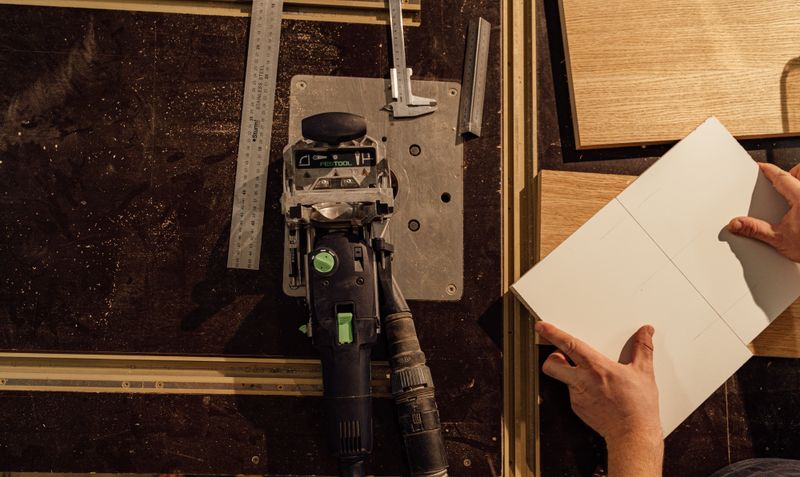
The Domino DF 500 cuts mortises in widths of 4, 5, 6, 8, and 10mm, with three depth settings for each. The larger Domino XL (DF 700) handles mortises up to 14mm for heavy timber framing. The Festool DOMINO DF 500 Joiner is the standard for furniture-scale joinery.
The Domino costs significantly more than a biscuit joiner — $800 to $1,000 for the DF 500. Domino tenons also cost more than biscuits, though they are still affordable for most projects.
Strength Comparison
Domino joints are significantly stronger than biscuit joints. This is not a subjective judgment — it is a measurable, repeatable fact. A Domino mortise provides a much larger gluing surface than a biscuit slot. The flat, parallel walls of a Domino mortise create full-face contact between the tenon and the mortise walls. A biscuit slot has curved walls that only contact the biscuit at the high points.
In shear testing, Domino joints typically fail at 2 to 3 times the load of equivalent biscuit joints. For structural applications like chairs, tables, and load-bearing frames, the Domino’s strength advantage is decisive.
However, biscuit joints are strong enough for many common applications. Panel glue-ups, cabinet face frames, and alignment tasks do not require the maximum possible joint strength. The biscuit serves primarily as an alignment aid in these situations, and the glue between the panel faces provides the actual strength.
Precision Comparison
The Domino delivers superior precision. The indexing system, the positive stops, and the rigid cutting mechanism produce mortises that are consistent to within 0.1mm. This consistency allows you to cut all the mortises in a project, dry-fit everything, and have every joint align perfectly.
Biscuit joiners are less precise. The crescent-shaped slot is wider than the biscuit, allowing side-to-side play of 1/32 to 1/16 inch. This play is actually intentional — it allows for slight alignment adjustments during assembly. But it means biscuits are not suitable for joints that require precise, repeatable alignment.
Speed Comparison
Both tools are fast, but the biscuit joiner is slightly quicker for simple joints. Cutting a biscuit slot takes about 2 seconds — plunge the blade, retract, move to the next location. Cutting a Domino mortise takes about 5 seconds per slot because the bit must plunge deeper.
However, the Domino’s precision often saves time overall. When joints align perfectly on the first try, you spend less time fussing with dry fits, adjusting alignment, and fighting mismatched parts.
Best Applications
Use a Biscuit Joiner For:
- Panel glue-up alignment — biscuits keep boards aligned edge-to-edge during clamping
- Cabinet face frame assembly — biscuits align rails and stiles quickly
- Miter joint reinforcement — biscuits strengthen mitered corners in picture frames and boxes
- Light-duty joinery — non-structural connections where alignment matters more than strength
Use a Domino For:
- Frame construction — table aprons to legs, chair rails to legs, door frames
- Structural joinery — anywhere the joint bears weight or resists racking forces
- Precise repetitive joinery — production work where every joint must be identical
- Floating tenon applications — replacing traditional mortise-and-tenon with a faster alternative
The Verdict
If budget allows, the Festool Domino is the superior tool. It produces stronger, more precise joints and handles a wider range of applications. For professional woodworkers and serious hobbyists, the Domino is a transformative tool that pays for itself in time saved and joints perfected.
If budget is a concern, the biscuit joiner provides excellent value. It handles panel alignment and light joinery tasks perfectly well at a fraction of the cost. Many woodworkers own both tools — the biscuit joiner for quick alignment tasks and the Domino for structural joinery.
The Kreg Pocket Hole Jig K5 offers a third option for fast joinery, particularly suited to cabinet assembly and face frame work where speed matters more than traditional aesthetics.
Fit, Alignment, and Glue-Up Workflow
Both biscuits and Dominos work best when you reference from the same face on every part. Mark the show face and keep the tool’s fence against that face consistently. If you reference one board from the top and the mating board from the bottom, small thickness differences can create a visible step.
For panel glue-ups, place alignment aids every 8 to 12 inches, but do not overdo it. Too many biscuits can make the joint harder to close before the glue begins to tack. Dry fit the panel, prepare clamps before applying glue, and keep the parts in sequence so grain and color still match.
When Neither Tool Is the Answer
A biscuit joiner and Domino are helpful, but they are not magic replacements for all joinery. Very thin stock may not have enough thickness for either method. Outdoor furniture may require joinery and fasteners designed for movement, water, and racking forces. High-end visible work may still call for traditional mortise-and-tenon, dovetails, or carefully cut dados.
Choose the method that matches the load, appearance, budget, and repeatability you need. The best joinery decision is the one that makes the project stronger and easier to assemble, not simply the one that uses the newest tool.
Related Articles
If you are exploring your joinery options, our pocket hole joinery guide covers when pocket screws excel and how to get the strongest results. For traditional woodworking joints that require neither a biscuit joiner nor a Domino, see the guide to dado and rabbet joints. Those interested in the highest level of precision joinery may also enjoy reading about Japanese joinery techniques and the philosophy of fitting wood without metal fasteners.

The Carpenter's Guide Editorial Team
Independent trade-focused editorial team